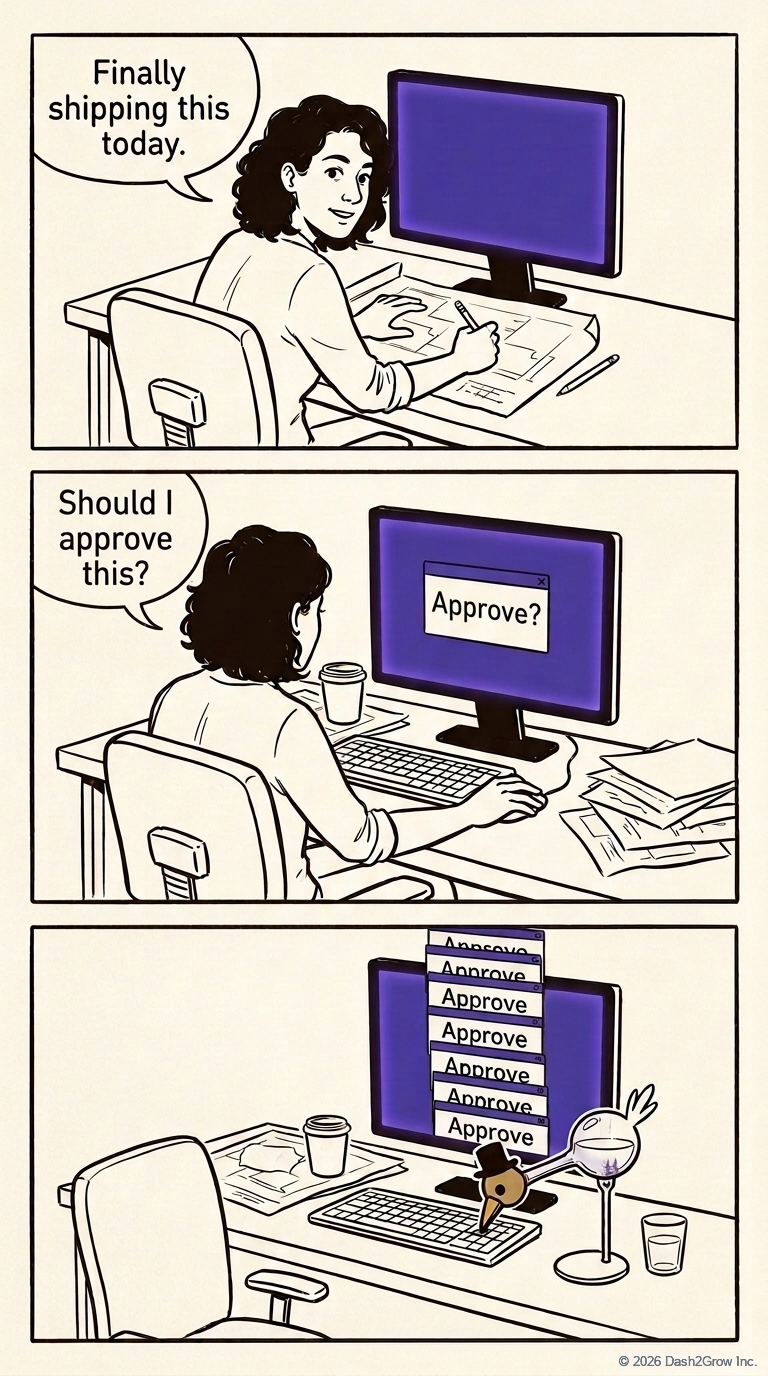
Our job used to be deciding. Now a lot of it is approving, and the difference matters more than it sounds.
Watch anyone working with an AI agent for an afternoon. The work starts the way work has always started: a problem, a half-drawn plan, something being made. Then the prompts arrive. Allow this. Allow once. Allow. Each one is reasonable on its own, each one takes about a second, and by the middle of the afternoon the plan is under a coffee cup and the job is the clicking.
Why does approving turn into a reflex?
Nobody decides to stop reading. It happens the way most process failures happen, one sensible step at a time. The tool asks a fair question, the person gives a fair answer, and the hundredth fair answer is no longer an answer. It is a reflex with a keyboard shortcut.
The maths is unkind. Four hundred approvals in a day leaves about four seconds for each one, and nobody reads anything in four seconds. So the approving continues and the reading quietly stops, and from the outside the two look identical.
Is a gate you always say yes to still a gate?
No. It is a delay you have agreed to tolerate, dressed up as oversight, and it is worse than having no gate at all because it looks like control to everyone who is not sitting at that desk. The person clicking has not been given more power over the work. They have been given a smaller job and a longer day.
That is the test worth applying to any approval step you own. If the answer has been yes every time for a month, it is not protecting anything. It is charging rent.
What does a real gate look like?
Fewer, and better. Batch the routine so it stops asking. Allowlist the boring so it never asked in the first place. Then save the real review, the kind that deserves somebody’s whole attention, for the things that cannot be undone. Three considered decisions beat four hundred reflexes, and they take less of the day.
We rebuilt our own system around that this week. A checklist for a task now loads itself instead of waiting to be remembered. A script refuses work that arrives out of order instead of warning about it. A person only gets asked the questions that actually need a person. The machine screens first, the human decides last, and the decisions that reach us are the ones worth making.
The drinking bird in the cartoon is doing the job perfectly. That is the joke, and it is also the warning. If the work can be done by something that cannot read, the gate was never the safeguard anyone thought it was.