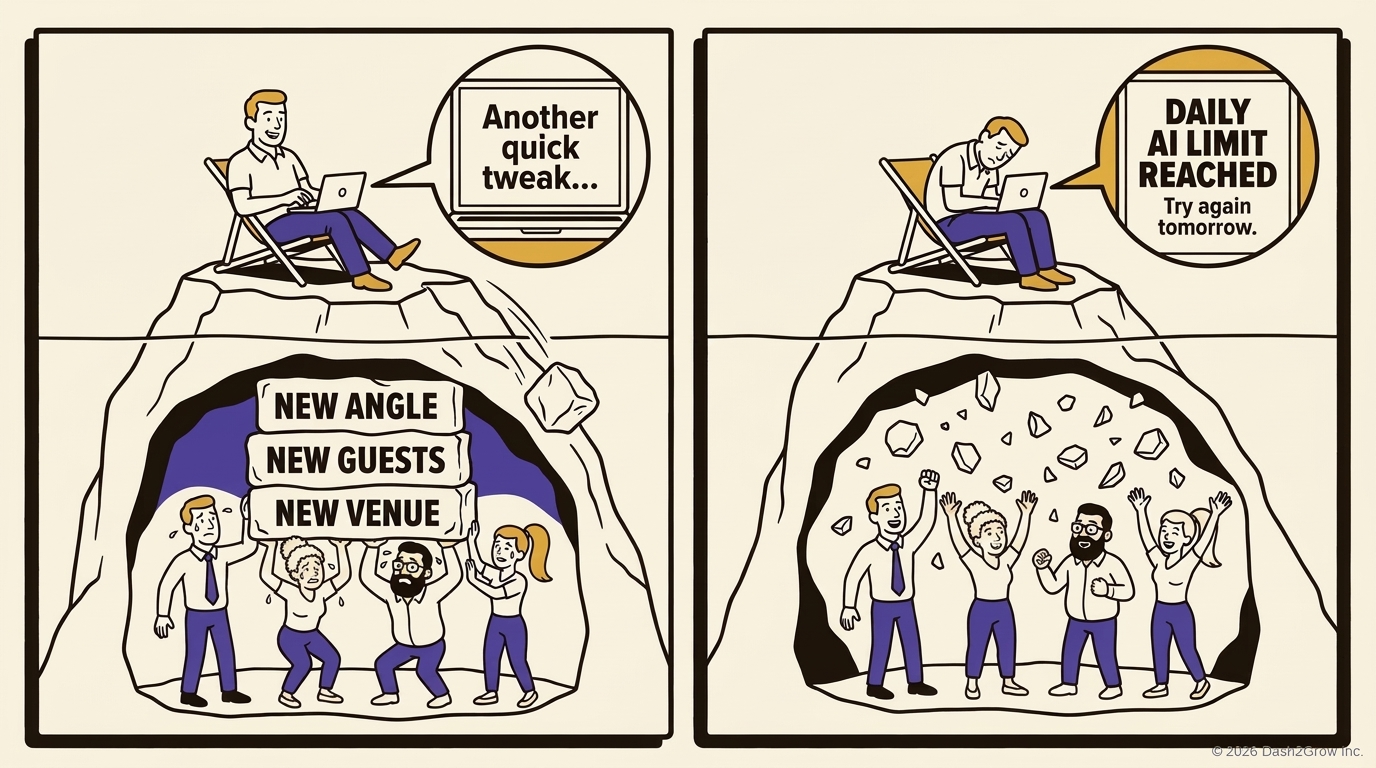
I was asked to help build a briefing note for a senior leader’s meeting. We used AI to research the attendees, write the questions and pull in trusted industry stats. Then the angle changed, the guests changed, and the location moved.
We went through about 3 core revisions before the meeting was cancelled.
While the team was still scrambling, the leader asked for a status update on something else. In their head, the meeting was simply cancelled.
Call it the AI iceberg. Leaders see the small tip: one quick prompt, one quick pivot. The team carries everything under the water.
Why can’t leaders see the AI iceberg?
Hemingway’s iceberg theory says a story works because the writer knows everything below the surface, even the parts left out. The AI iceberg flips that. The leader leaves out what’s below the water because they never knew it was there.
AI makes the tip almost free. A new idea, a new angle or a new guest list takes moments.
But every pivot still has to be validated, reviewed, tweaked and, most of all, verified, so the leader doesn’t look bad. That work lands on the team, and it always arrives urgent and last minute.
Does AI slop at the top reach customers too?
It does. I watched a company rebuild its website with AI. The AI produced two sections with almost identical offers and service packages, and the team shipped both.
They liked the shiny layouts and the buzzy, repeatable words. They didn’t see the strategy underneath.
Now every visitor has to work out the difference between two offers that look the same. The AI iceberg doesn’t stay inside the company. It grows in front of your customers.
Why is the AI iceberg easier to see in code?
In code, the iceberg shows. Every pull request on GitHub shows what changed, what got rolled back, what got tweaked and what reviewers said about it. You can watch the cost of a pivot line by line.
In the rest of the business, there’s no pull request for a pivot. The rework in a briefing note or a website is real, but nobody tracks it, so nobody up top sees it.
That’s why I keep half-joking about a usage limit. Our AI tools come with one. Maybe leaders need one too: a daily limit on new asks, and a weekly review of what those asks really cost the team.
Moving fast with AI feels like leadership, and a lot of the time it is. But every quick change at the top makes the AI iceberg bigger, and the people under it can’t easily see it, monitor it or change it.
Previously: AI Was Supposed to Replace Us. Instead, AI Needs AI to Check It.